

Let’s be honest. For the past twenty years, home audio has been boring. We swapped giant wooden boxes for sleek soundbars, replaced a bird’s nest of cables with a patchy Wi-Fi connection, and called it a revolution. Utter nonsense.
But that era of incremental tweaks is over. The next wave of home audio technology is so genuinely clever, so aggressive in its pursuit of sonic perfection, that it makes my hair stand on end. We are moving beyond mere listening and heading straight into total, auditory immersion. The goal? To make you believe you’re there.
If you think your little Amazon Echo Dot (5th Gen) is smart, wait until you meet its grandchildren.
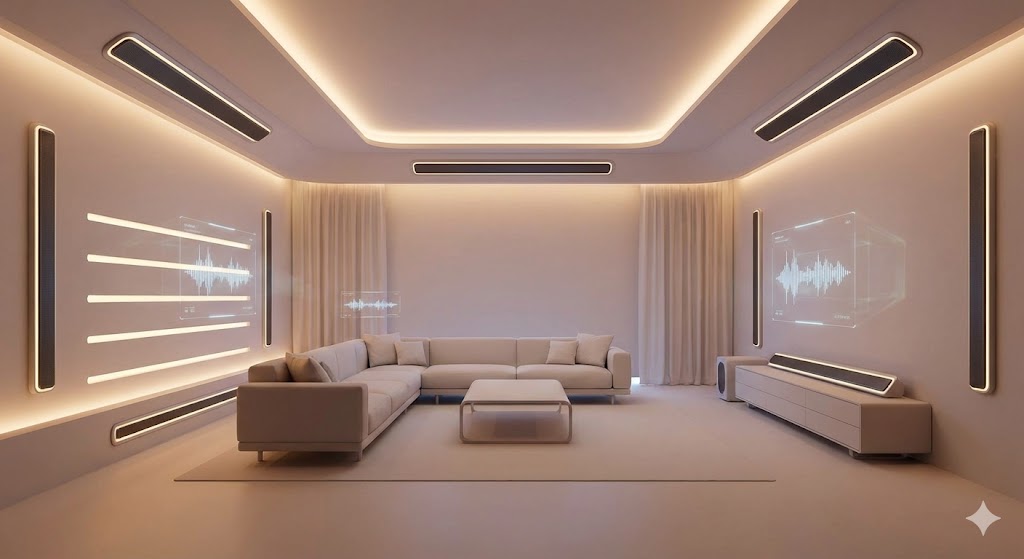
I. Acoustic Cartography: The End of Bad Acoustics
Forget buying sound-dampening panels that make your living room look like a padded cell. The problem with current home audio—even high-end stuff—is that it assumes your room is a perfect, padded void. Newsflash: it isn’t. It’s full of bouncy plaster, reflective glass, and lumpy sofas that gobble up bass frequencies.
The next generation of audio systems won’t just adjust volume; they will perform a digital acoustic lobotomy on your space.
The Rise of Room-Mapping DSP
We’re already seeing the foundations of this in products like the Apple HomePod mini, which uses its brain to understand its immediate position. The future takes this to a surgical extreme:
Acoustic Mapping: Sensors built into the speakers (or even tiny, discreet devices placed around the room) will create a 3D map of your space. They will precisely identify every bounce, every flutter echo, and every bass trap. This isn’t just about simple EQ; it’s about modeling the wave physics of your room.
Targeted Cancellation: The system then uses Digital Signal Processing (DSP) to fire inverse sound waves only at the offending reflections. The result is sound that is utterly pure, clean, and entirely unaffected by the room’s messy imperfections.
Directional Sound Beaming: Imagine two people on the same sofa listening to two different podcasts, with only a few inches of space between them. Emerging “Audio Spotlight” technology uses focused ultrasound to create narrow beams of sound, allowing for hyper-localized listening zones. No headphones required.
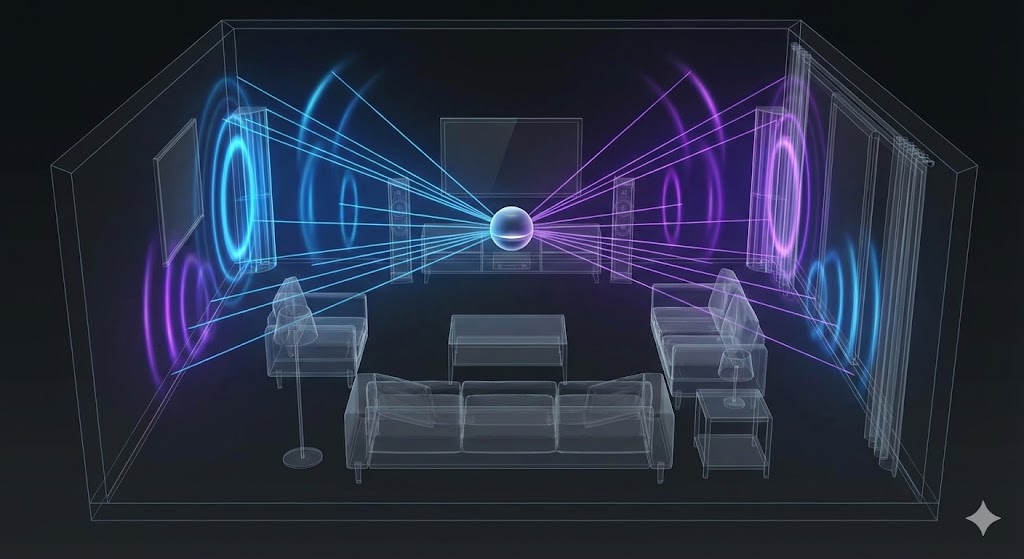
II. The Invisible Orchestra: Immersive, Object-Based Audio
This is where things get properly exciting, where music and movie sound moves from two dimensions into three.
For 50 years, stereo gave us left and right. Then surround sound gave us left, right, center, and behind. It was a flat, channel-based approach. The future is Object-Based Audio—namely Dolby Atmos and rival Spatial Audio formats.
Sound as Objects: In these formats, a helicopter, a guitar riff, or a whispered voice is treated as a single, independent audio object. The music producer or film mixer can place this object literally anywhere in a 3D space: 10 feet in front of you, directly above your head, or orbiting your left ear.
The Processor Renders Reality: The system doesn’t play a ‘channel,’ it takes the object’s spatial coordinates and instantly renders the sound through your unique speaker setup to place that object exactly where it should be. The sound system becomes a powerful supercomputer, not just an amplifier.
Verticality is the New Bass: The greatest impact of this shift is the addition of the vertical dimension. When the sound of a rainstorm can convincingly come from your ceiling, the entire experience is fundamentally altered. It stops being a recording and starts being an environment. This is why you need to be looking for home systems that support Dolby Atmos and DTS:X right now, as we covered in our deep dive on the best home cinema upgrades.
III. Tactile Transduction: When You Feel the Sound
This is the point where audio leaves your ears and enters your bones.
We talk about deep bass, but in reality, much of what we feel from bass isn’t sound energy, it’s vibration. The next step is the purposeful use of haptic technology—the same tech that makes your smartphone gently buzz—to create controlled, tactile audio effects.
Haptic Furniture: Imagine a modular couch where tiny, powerful transducers vibrate independently, giving you the rumble of a passing truck through your feet while the percussion of a drum solo tingles your back.
Structural Audio: Entire walls or floors could be turned into massive, low-frequency sound radiators. This isn’t a subwoofer; it’s the building itself becoming the sound source, radiating energy below the threshold of hearing that you perceive purely as physical sensation.
Ultra-Light, Ultra-Rigid Drivers: To handle the immense dynamic range of these new formats, we’re seeing a focus on exotic materials. Cones made from materials like synthetic diamond, Kevlar, or high-density carbon fiber allow drivers to move incredibly fast and stop instantly, virtually eliminating distortion. The sound is surgical and clean, a massive leap from even the best-selling retro speakers like the Marshall Emberton III, which are all about warm character.
As we discussed in our article about the music tech revolution, these advancements are changing what artists can even create.
IV. The Speaker That Disappears
The final frontier is aesthetic nirvana. No one wants an ugly black box dominating their carefully curated room.
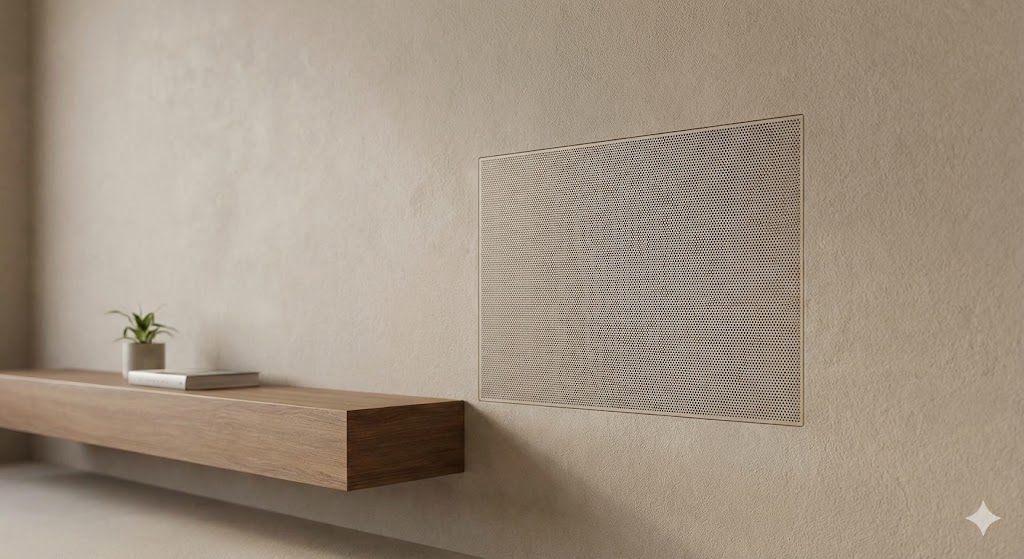
Acoustic Transparency: We are seeing a shift to materials that are completely invisible to sound. Manufacturers are experimenting with ultra-thin, almost transparent mesh or materials that allow sound waves to pass through unimpeded, allowing the drivers to be hidden behind furniture or art without any sonic compromise.
In-Wall Utopia: Speakers aren’t on the wall; they are the wall. Flat-panel speakers and exciters are evolving, using the wall itself as the diaphragm, radiating sound evenly across the surface. This creates an even, ambient sound field that is perfect for background music or environmental noise masking (a la the HomePod Mini’s white noise function, but scaled up).
The Smart Amplifier: Finally, the amplifier is shrinking and disappearing. Powerful Class D switching amplifiers, which are tiny and generate virtually no heat, are now often built directly into the speakers themselves, eliminating the need for those hideous, black AV receivers that look like a 1980s data center. This trend is already accelerating, allowing you to simply buy a pair of high-end bookshelf speakers on Amazon and plug them straight into the wall—no receiver necessary.
The technology is already escaping the labs and landing in flagship products. The revolution isn’t coming; it’s already here, and it’s sounding magnificent.